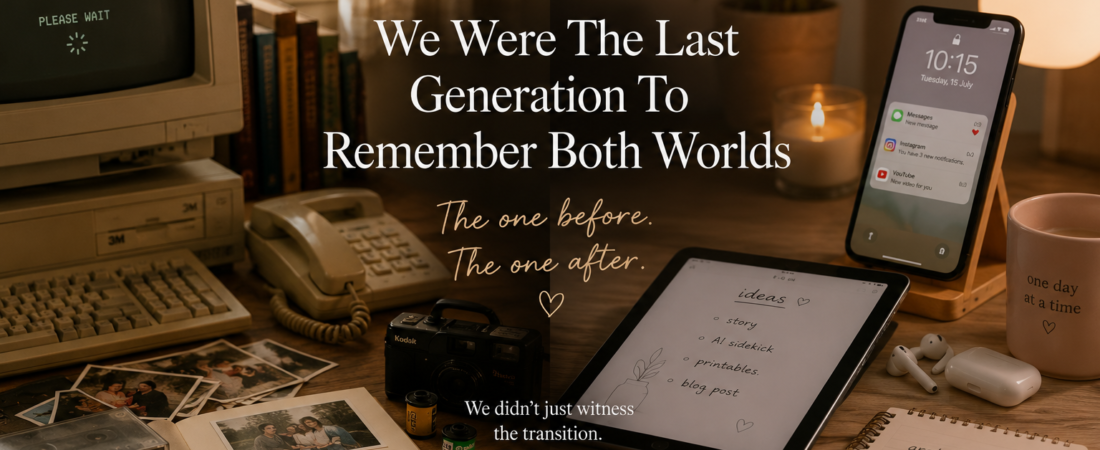
Sometimes I wonder if we were the last generation to live two completely different childhoods.
The first was mostly offline.
The second slowly moved online.
And somehow, we grew up in both.
When I was a child, the internet wasn’t woven into everyday life. It was something you visited. You sat in front of the family computer. Waited patiently for the dial-up connection. Hoped nobody picked up the telephone halfway through. Once you logged off, that was it.
Life continued somewhere else. Outside. Our childhood memories weren’t stored in cloud albums. They lived in printed photographs tucked inside family albums. Birthday parties weren’t documented from ten different angles. Sometimes there were only two or three blurry photos, and somehow that was enough.
If we wanted to talk to our friends, we called the house phone and nervously hoped their parents wouldn’t answer. If we wanted to know something, we looked it up in books or asked someone older. Waiting wasn’t unusual. It was simply part of life. Then, almost without us noticing, everything began to change.
- The internet became faster.
- Smaller.
- Portable.
- Social media arrived.
- Search engines became part of daily life.
- Smartphones quietly moved into our pockets.
Suddenly, the internet wasn’t somewhere we went. It became the place where so much of life happened.
Our friendships.
Our memories.
Our shopping.
Our learning.
Our work.
Even our quiet moments.
Looking back, I don’t think we realised we were witnessing such a huge transition. We simply adapted. We learnt new platforms. Created new passwords. Downloaded new apps. Without ever stopping to think that we were becoming the bridge between two entirely different worlds.
Today, I watch my children navigate technology with a confidence I never had at their age. To them, video calls are normal. AI conversations are normal. Streaming anything at any time is normal.
They’ve never experienced a world where the internet wasn’t already waiting for them. And one day, they’ll probably struggle to imagine the childhood I had. Just as I struggle to imagine the childhood my grandparents had. That’s how generations work.
Every childhood feels ordinary while you’re living it. Only later do you realise it belonged to a particular moment in history. Perhaps that’s why millennials feel so nostalgic. We remember enough of the old world to miss it. But we’ve lived long enough in the new world to appreciate it too.
We know the joy of handwritten letters. And the convenience of instant messages. We remember getting lost with paper maps. And the comfort of GPS. We remember waiting a week for the next television episode. And now we complain if a streaming service releases episodes one at a time. We laugh at ourselves sometimes.
But perhaps our nostalgia isn’t really about old technology. It’s about remembering a slower rhythm of life. A world where boredom often led to imagination. Where friendships weren’t measured by followers. Where photographs weren’t taken with the expectation that strangers might see them.
I’m grateful my children have opportunities I never had. I wouldn’t want them to lose access to the knowledge and connections the internet has made possible. But every now and then, I hope they also experience little pieces of the world we once knew.
An afternoon without notifications. A conversation that isn’t interrupted by a screen. The excitement of discovering something without an algorithm deciding it for them. Because while I wouldn’t trade today’s technology, I do feel incredibly fortunate to remember life before it became inseparable from who we are.
Maybe that’s what makes millennials unique.
We weren’t the first generation to grow up with technology. And we certainly won’t be the last. But we might have been the last generation to truly remember both worlds. The one before the internet shaped every part of our lives. And the one after.
Looking back now, I realise we didn’t just witness that transition. We became part of it.
Ummi Noi