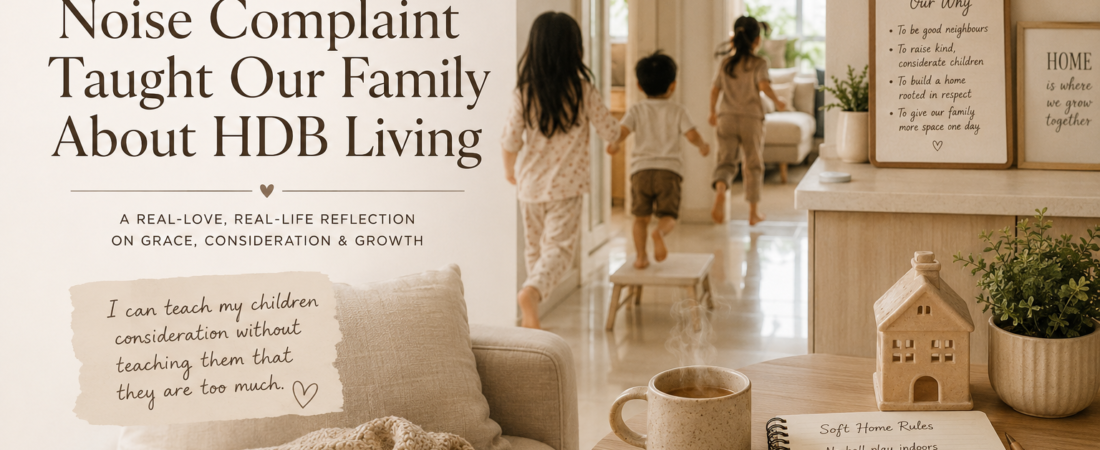
Our first matrimonial home—the home where we first took root as a family—was a second-floor BTO.
For years, one of the things we were quietly grateful for was that there was no neighbour living directly below us. We never had to think too deeply about the sound of little feet running through the house, toys dropping, chairs moving, or children jumping in excitement.
Then our family grew.
Like many Singaporean families, we eventually needed more space, so we upgraded to a larger home.
This time, someone lived beneath us. I love that my children enjoy being at home.
Perhaps the pandemic shaped them that way. A significant part of their childhood was spent indoors, learning how to play, imagine, argue, reconcile, and entertain themselves within the walls of home.
Home became their playground. They ran. They jumped. They chased one another. Sometimes, they even played with a ball indoors.
I reminded them countless times:
“We don’t live on the second floor anymore. There are people living below us now.”
But do children truly understand how their footsteps sound through someone else’s ceiling?
Do they remember every reminder once they become caught up in a game?
Not always.
And the uncomfortable truth was that this was not one isolated burst of noise. Running, jumping, shouting, and even indoor ball play had gradually become normal in our household.
Then one Saturday night, the doorbell rang.
I was home alone with the children while my husband was out getting groceries. When I opened the door, a couple introduced themselves as our downstairs neighbours.
They explained that the running, jumping, and thumping from our home had been disturbing their family’s rest. They had tried to tolerate it for some time, but it had reached the point where they felt they needed to speak to us directly.
At that moment, I was deeply thankful for the outdoor camera we had installed. Not because I believed they came with ill intentions. The entire exchange remained civil. But the camera created a quiet layer of protection for everyone. It recorded what happened, reduced the possibility of misunderstanding, and allowed my husband to witness the interaction even though he was not physically there.
While I tried to listen, my little gremlins were still creating chaos behind me.
The irony was painful.
The neighbours were explaining how disruptive the noise had been while the children continued making so much noise that I struggled to hear parts of the conversation. I had to rely heavily on their body language. At several points, I thought the exchange had ended, only to realise that either the husband or wife still had something they wanted to express. So I listened.
They had clearly been holding their frustration for some time, and I did not want to dismiss them simply because the conversation was uncomfortable for me. I told them I appreciated that they had come upstairs to speak to me directly. I sincerely apologised on behalf of my children and myself. I acknowledged that I had not managed the noise well enough and that our household had caused inconvenience to theirs.
At the same time, I did not want to make a promise I could not keep. My youngest child is only three. I could not honestly promise that my children would suddenly become silent.
So I told them:
“I can’t promise that my children will never make noise again. But I will do my best to control the running, jumping, and thumping.”
I also told them that I genuinely wanted a good relationship with my neighbours, not a strained one. The conversation ended peacefully.
But after I closed the door, my nervous system did not immediately understand that the situation was over. Logically, I knew we were safe.
The neighbours had left. The exchange had remained respectful. Nobody had threatened us or raised their voice. Emotionally, however, I felt exposed.
Embarrassed. Ashamed. Hyper-aware of every sound my children made. Every footstep suddenly sounded too loud. Every burst of laughter made me wonder whether it was travelling downstairs.
One sentence about how peaceful things had been before our family moved in landed more painfully than they probably intended. My body did not hear it merely as a comment about noise.
It heard:
“Everything was fine until your family arrived.”
That was the part that hurt most.
It took time for my body to catch up with what my logical mind already knew: this was a valid noise complaint, not a verdict on my family’s worth. Looking back, I also realised that this was not my first experience with sound travelling between HDB units.
In our previous home, the family above us had a young child. We occasionally heard the familiar thumping of running, jumping, and little feet moving across the floor. Perhaps I had a higher tolerance because I was raising several children of my own. The sounds felt familiar to me. I understood where they came from. Most of the time, I heard them and simply thought, Children.
But not every household has the same threshold. A sound that feels ordinary to one family may feel exhausting to another after a long day. A parent who lives with children’s noise every day may interpret it differently from someone whose home is usually quiet. That does not automatically make one household more reasonable than the other. It simply means we experience noise through the lens of our own lives.
After sitting with the discomfort, I realised that the night was not only a negative experience.
It was also a turning point. For the first time, my children experienced firsthand that the noise we create inside our home does not always end at our walls. It travels into someone else’s space. They saw that actions have consequences. They saw that living in a shared building requires awareness, respect, and adjustment.
And I was reminded that accountability does not have to come with humiliation. I could acknowledge my neighbours’ frustration without agreeing that my children were bad. I could apologise without accepting the belief that our family was unwanted. I could teach my children to be considerate without teaching them that their existence was a disturbance.
That balance is not easy. This is the reality of HDB living.
Children need room to move. Neighbours need room to rest. Both truths matter.
So changes have to be made. No more ball play indoors. Less running and jumping, especially at night. More awareness of shouting, furniture movement, and impact noise.
Perhaps thick rugs or cushioned play mats in the busiest parts of the house. Not because my children should be afraid to exist inside their own home. Not because children must remain silent.
But because we share this building with other families, and consideration is part of growing up. At the same time, the experience clarified something deeper for me. One day, I hope to give my family a home with more space. A home where each child has a room of their own. A home with outdoor space where active play does not happen directly above another family’s ceiling. A home with a dedicated office where I can write, create, and build the work that supports our future.
That dream is not about running away from responsibility. It is about designing a life that better fits the family we have become. Until then, this is our home.
We will continue teaching our children that their actions affect others. We will adjust what needs to be adjusted. We will try to protect our neighbours’ peace without turning our home into a place where everyone is afraid to move.
Because perhaps the real lesson was never that children should become quieter.
It was this:
I can teach my children consideration without teaching them that they are too much.
And being a good neighbour is also part of teaching them how to become good human beings.
Ummi Noi