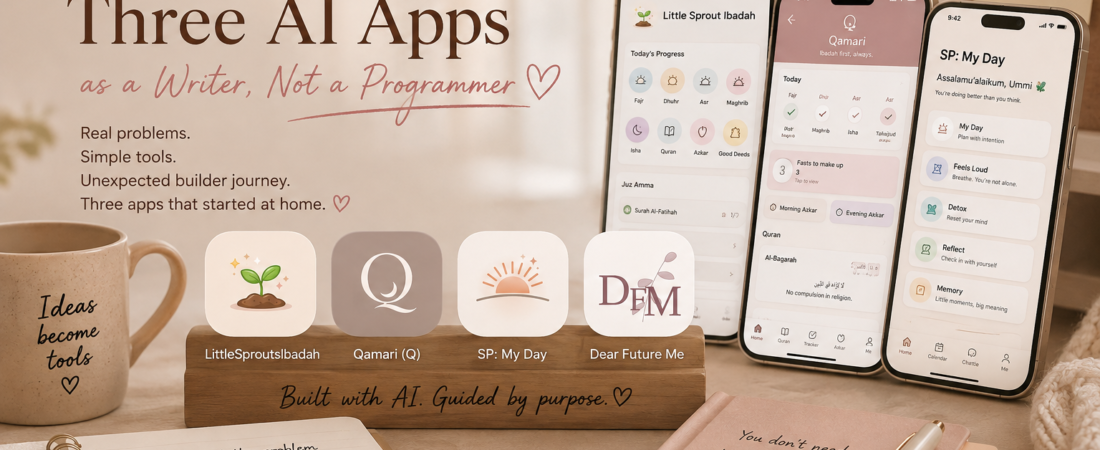
If you had told me a year ago that I would build three AI-powered apps, I probably would have laughed.
Because I am not a programmer. I didn’t study Computer Science. I can’t sit in front of a blank code editor and casually build an application from scratch.
I’m a writer. A mother. A digital creator who has spent far more time thinking about stories, parenting resources and words than software development. And yet somehow, within the span of a few months, I found myself building apps using Base44, Emergent and Google AI Studio.
The funny thing is, none of this started because I wanted to build an app. It started because I was manually tracking my children’s prayers.
Little Sprout Ibadah Started With A Very Ordinary Problem
I wanted my children to become more consistent with their ibadah. So I was doing what mothers have been doing forever when we want to keep track of something. I tracked it myself. Nothing particularly revolutionary was happening here. At around the same time, I kept seeing advertisements for AI app builders.
Base44.
Emergent.
Again. And again. And again.
Eventually I thought:
You know what? Let’s try it.
That was genuinely how this whole thing started. I settled on Base44. There was only one fairly significant problem.
I didn’t know how to code.
But I did know how to explain what I wanted. And by then, ChatGPT already knew a lot of my context and workflow. I had been using it to think through my writing, products, parenting ideas and the different things I was creating. So I started there. I explained what I wanted to build. We worked through how it should function.
ChatGPT helped me translate what was inside my head into prompts and code that I could then use with Base44. And slowly, Little Sprout Ibadah began to exist.
Then I Couldn’t Stop Adding Things 😅
Little Sprout Ibadah started relatively simple. A way to help my children track their ibadah.
Then, naturally, I started thinking:
– Okay, but what if it could also do this?
– And this?
– And THIS?
The Base44 credits disappeared rather quickly. But I was satisfied. The simple app started becoming something that actually reflected how I wanted our family to use it.
I created separate Kids Mode and Parent Mode experiences. I added the ability to connect a parent or partner. I built in a Juz Amma list so the children could keep track of the surahs they were learning. I added transliteration with the option to toggle it on or off depending on your preference.
And then came one of my favourite features:
Ramadan Mode.
I didn’t want Little Sprout Ibadah to become one of those things that felt relevant during Ramadan and then sat forgotten for the remaining eleven months. So Ramadan Mode could be switched on when we needed it and switched off afterwards. The app could remain useful throughout the year. And then came the most important test.
My children actually used it. They loved it. I loved it.
That was the moment something changed for me. Because I hadn’t built a hypothetical product for some imaginary user on the internet. I had started with something I was already doing manually inside my own home and built a tool that made it better.
I still didn’t think of myself as someone who built apps. Not yet, anyway.
Then Little Sprout Made Me Think About Muslim Women
Once Little Sprout existed, another thought started bothering me.
What about us? A Muslim woman’s relationship with ibadah doesn’t always fit neatly inside a conventional habit tracker.
Our routines change throughout the month.
There are days we don’t pray.
There are fasts we may need to replace.
There are different rhythms to maintaining our relationship with Allah.
And I didn’t want to create a period tracker with a few Islamic features attached to it. I wanted the hierarchy to be completely different.
Ibadah first. Simple period tracking second.
That idea became Qamari, or Q.
This Time, I Tried A Different Builder
Remember those Base44 and Emergent advertisements I kept seeing before Little Sprout? I had chosen Base44 the first time.
For Qamari, I decided:
Okay. Let’s try Emergent.
And I’m glad I did. Because switching platforms accidentally taught me something important.
I wasn’t learning how to use Base44. I was learning how to build with AI. The platform had changed. But my role hadn’t.
– I still needed to understand the problem.
– I still needed to know who I was building for.
– I still had to explain what I wanted.
– I still had to test what came back.
And I still spent plenty of time going:
No no no. That’s not what I meant. 😭
Then trying again.
Qamari Became Ibadah First
Qamari was designed specifically for Muslimah. Period tracking exists, but deliberately as a simple part of a much larger experience. Because Q isn’t supposed to make menstruation the centre of a Muslim woman’s spiritual life. It’s supposed to help her maintain her relationship with Allah through the different rhythms of it. Q can help keep track of how many missed fasts need to be replaced. Morning and evening azkar are built into the experience.
And where Little Sprout Ibadah includes Juz Amma for children, Qamari was built with the full Quran for adults.
Both apps also have optional transliteration.
Need it?
Toggle it on.
Prefer reading without it?
Toggle it off.
These might sound like tiny product decisions. But this was where I started understanding something I hadn’t really thought about when I began. I wasn’t coming up with features because I knew how to programme them. I was coming up with features because I understood the person using them.
I Was Building From Lived Experience
I think this distinction matters, especially now that AI makes it possible to generate things incredibly quickly.
I wasn’t sitting around asking:
What kind of AI app can I make?
Little Sprout Ibadah existed because I was manually tracking my children’s prayers.
Qamari existed because I understood the experience of being a Muslim woman trying to maintain her ibadah throughout the month.
The problem came first. The technology came afterwards.
And maybe this is where being a writer helped me more than I initially realised. Writers spend an absurd amount of time thinking about people.
– What does this person want?
– What frustrates them?
– What are they struggling with?
– What would make something feel natural?
– What would make them stop using it?
– What would make them come back?
For years, I asked those questions about characters. Now I was asking them about users.
Then Google Told Me To Build An App
Okay, not quite like that. 😅
But my third app came about differently from the first two.
By this point, I had built Little Sprout Ibadah using Base44.
I had built Qamari using Emergent.
And I was taking Google’s AI courses because I wanted to understand this world I had somehow wandered into.
One of the modules involved creating an app with AI using Google AI Studio.
So there I was, learning how to build applications with AI…
while building another application with AI.
Naturally.
That became SP: My Day.
SP: My Day Was Learning And Building At The Same Time
SP: My Day grew out of my work with SimplyPlanned.
I didn’t want another productivity tool whose entire purpose was to help someone cram more tasks into an already overwhelming day. I wanted something gentler. A place that recognised that sometimes you don’t need another productivity hack. Sometimes life just feels loud. So the app began taking shape around different spaces.
My Day.
Feels Loud.
Detox.
Reflect.
Memory.
I created a clickable calendar. I started imagining how the experience could eventually grow, including adding Chattie as a conversational layer.
But what made SP: My Day particularly meaningful to me wasn’t just what I was building. It was how I was building it.
Something would come up in my Google course and instead of writing it down and thinking:
This might be useful one day…
I could immediately apply it. I was learning and building at the same time. And suddenly I could look backwards and see this strange little trail behind me.
Little Sprout Ibadah — Base44.
Qamari — Emergent.
SP: My Day — Google AI Studio.
Three apps. Three different environments. And somehow…
still not a programmer.
That’s When I Couldn’t Call The First One A Fluke Anymore
After Little Sprout Ibadah, I could have told myself Base44 did all the work.
Then I built Qamari somewhere else.
Then SP: My Day happened somewhere else again.
Eventually I had to acknowledge the common denominator.
Me.
Not because I had secretly become brilliant at coding. I hadn’t. But I had become much better at something I didn’t initially recognise as a technical skill.
– I could take an idea and explain it.
– I could define a problem.
– I could think through the person using the product.
– I could describe what I wanted something to do.
– I could look at what AI produced and recognise when it didn’t match what I had imagined.
– I could explain why.
Then revise.
Test.
Break something.
Fix it.
Change my mind.
Build again.
Which, now that I think about it…
sounds suspiciously like writing.
Maybe Writing Prepared Me For This More Than I Realised
When I’m writing a story, I don’t type the first sentence and magically arrive at the finished book. I imagine something. I give it structure. I write. I read it back. Something doesn’t work. I rewrite it.
A character behaves strangely. A chapter drags. An idea that sounded brilliant inside my head turns out to be terrible once it exists on the page. So I change it.
Again.
And again.
Until what exists outside my head starts resembling what I imagined inside it.
Building with AI felt strangely familiar. The medium had changed. The process hadn’t changed as much as I expected.
ChatGPT Became The Bridge
I think this is also why having AI that already understood my context made such a difference. I didn’t approach ChatGPT like a vending machine where I typed:
Build me an app.
There were conversations. Lots of them.
– I explained what I was trying to solve.
– I explained how I wanted something to work.
– We broke problems apart.
– I brought things back when they didn’t work.
– I changed directions.
– I questioned features.
AI could help translate those intentions into instructions and code. The app builders could turn those instructions into functional things. But someone still needed to decide what was worth building.
That remained my job.
AI Didn’t Replace My Creativity
If anything, building with AI required more clarity from me. AI could generate possibilities. It could produce code. It could suggest solutions when something broke.
But it couldn’t decide why Little Sprout Ibadah needed Ramadan Mode.
It couldn’t know how my children would actually use the app. It couldn’t decide that Qamari should be ibadah-first instead of period-tracker-first. It couldn’t understand the overwhelmed parent behind SP: My Day unless I explained that person.
Those decisions came from lived experience.
From parenting.
From faith.
From creating products.
From writing.
From being the person who had encountered some of these problems herself.
AI helped shorten the distance between the idea and the execution. It didn’t create the reason for building it.
And Then There Was Dear Future Me
Technically…
SP: My Day wasn’t the last app I built with Google AI Studio either. 😅
Later came Dear Future Me, or DFM.
By then, something had shifted again. Opening an AI builder didn’t feel like this wild experiment where I needed to find out whether someone like me was even capable of making something.
I already knew I could.
I had ideas.
I understood that an idea needed structure. I knew I could explain what I wanted, test what came back, recognise what wasn’t working and keep refining it.
Somewhere along the way, building stopped feeling like something reserved for “tech people.”
It simply became another way I created.
So technically, perhaps this entry should have been called:
How I Built Four AI Apps as a Writer, Not a Programmer.
But that’s not really the point. The first three changed what I believed I was capable of. Everything after that became evidence that the change had stuck.
I’m Still Not A Programmer
And I’m okay with that.
I don’t think everyone who builds with AI needs to reinvent themselves as a tech person.
I’m still a writer.
I’m still a mother.
I’m still someone who thinks in stories.
I’m still far more interested in why something should exist than whether I can impress someone with how it was built. But I will call myself something now that I probably wouldn’t have called myself before all of this.
A builder.
Because maybe building was never exclusively about knowing how to write code. Maybe it was also about seeing something that didn’t exist yet and thinking:
I think I know what this could become.
Then having enough curiosity to begin.
The Distance Between An Idea And A Thing Is Getting Smaller
That might be the part of AI that fascinates me most. For people like me, the distance between imagining something and making a version of it has suddenly become much smaller. That doesn’t mean expertise no longer matters. It doesn’t mean AI magically makes every idea good. And it definitely doesn’t mean you can switch your brain off and let AI do everything for you.
If anything, I’ve discovered the opposite.
– You still need judgement.
– You still need taste.
– You still need to understand the person you’re creating for.
– You need to recognise when something isn’t working.
– You need to know what shouldn’t be built.
– And you need a reason for creating it in the first place.
The tools will keep changing.
Base44 today.
Emergent.
Google AI Studio.
Something completely different tomorrow. But the tool was never really the story.
The story was the mother manually tracking her children’s prayers who kept seeing advertisements for app builders and finally thought:
You know what? Let’s try it.
She didn’t know that decision would lead to Little Sprout.
Or Qamari.
Or SP: My Day.
Or DFM.
She certainly didn’t think it would change how she saw herself. She just had a problem she wanted to solve. And perhaps that’s why I don’t think I built these apps despite being a writer.
I built them because I was one.
I understood people before I understood code.
I understood stories before I understood software.
And AI gave me a bridge between the two.
I’m still a writer.
I just discovered that sometimes, the things I write into existence can be used, clicked and opened too.
Ummi Noi