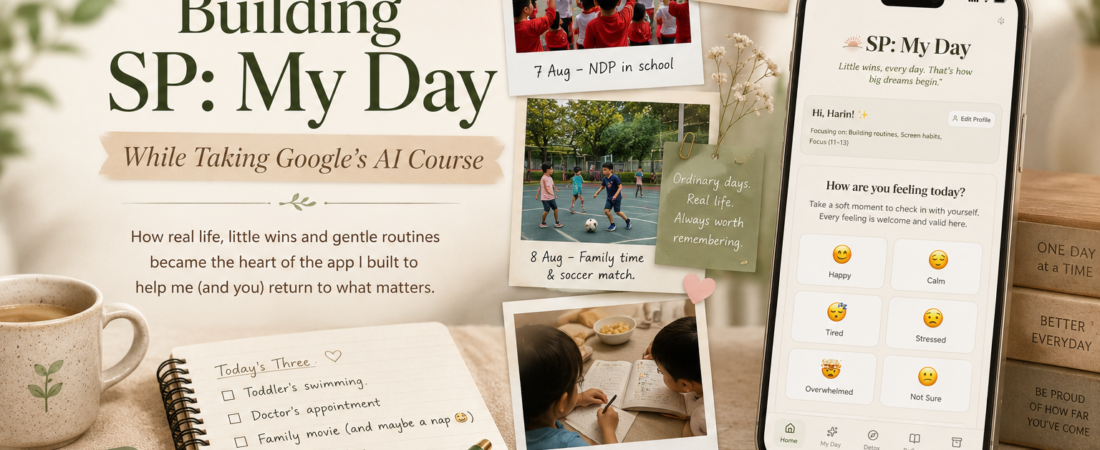
When I enrolled in Google’s AI for App Building course, I wasn’t trying to become a programmer.
By then I had already started experimenting with building apps using AI, so I was more curious about understanding what I was actually doing. I wanted to learn properly instead of just throwing prompts at an AI builder and hoping for the best. 😅
And somewhere in the middle of taking the course, I started building SP: My Day.
The funny thing is, SP: My Day probably makes more sense if I don’t begin by explaining the app at all. Let me tell you about my last three days instead.
Three Very Ordinary Days
On 7 August, the big kids had their National Day celebration in school while my toddler had swimming in the morning. Then in the afternoon we had doctor’s appointments before heading out again for a movie in the evening, so by then I was already tired enough to warn the kids that there was a very good chance I was going to sleep through whatever movie they had chosen.
Which I did. 😂
I have very little idea what happened in the movie, but honestly, everybody won. They enjoyed themselves, I got to sit in an air-conditioned cinema and sleep, and we still technically had a family movie outing.
The next day was the complete opposite. We didn’t have much planned at all. I bought a new soccer ball because my second-born has soccer in school and I thought she could use one to practise at home. Later that afternoon we brought the kids downstairs with their bicycles, hung around the playground and fitness corner, and when my husband joined us we somehow ended up playing soccer as a family. I played too, by the way. 😂
It wasn’t an “activity” I had planned for family bonding. We just went downstairs, the kids played, their dad joined us later and one thing led to another. But it turned into such a good late afternoon.
Then came 9 August itself.
Happy National Day, Singapore. 🇸🇬
Again, we didn’t do anything particularly special. My husband was working and the kids’ exams are in two weeks, so part of our day was spent revising Malay. I have recently decided that it is time for us to say goodbye to bad Malay 😂, which means Malay revision has become a regular occurrence in this house whether my children like it or not.
When it was finally time for the National Day Parade, the kids decided they would rather watch a movie. Fine.
Happy National Day, Singapore. My children are watching something else. 😅
And somewhere between writing this entry and looking back at those three days, I realised they actually explain SP: My Day better than any product description I could write.
Friday was full and I needed rest. Saturday had almost nothing planned and somehow became one of those really nice family afternoons. Sunday was mostly home, revision and letting the kids watch a movie instead of the parade.
None of those days needed optimising. They were simply different days requiring different things from me. And that was much closer to what I had in mind when I started building SP: My Day.
I Didn’t Want Another Productivity App
At first glance, SP: My Day probably does look like one. There are daily intentions. There are routines and habits. There is a place to reflect at the end of the day and a record of previous days.
But I didn’t want to build something that opened with an enormous to-do list and immediately made you feel behind. I already know what that feels like.
As a mother of four, I can wake up with what feels like twenty tabs already running in my head before I have even properly started the day. Who has school? Who needs what? Is there an appointment? What needs to be submitted? What are we eating? Did somebody tell me yesterday that they needed something today? And somewhere among all of that are my own work, writing and projects.
The last thing I need is an app informing me that I have also failed to drink eight glasses of water by 3pm. 😭
So SP: My Day begins somewhere else.
How are you feeling today?
Happy? Calm? Tired? Stressed? Overwhelmed? Not sure?
I like the Not Sure option especially because sometimes that genuinely is the answer. You don’t necessarily have the language for what is happening inside you yet. You just know today feels a little different. From there, the app asks what matters most today and gives you three spaces.
Only three.
If I had filled it in on Friday, mine probably would have been toddler’s swimming, doctor’s appointment and family movie. There would have been no requirement that I remain conscious throughout the third item. 😂
That is exactly the point. The goal isn’t to see how much you can squeeze into one day. It is to decide what actually matters in the day you have.
Little Wins Don’t Always Look Productive
Underneath the SP: My Day logo is the line:
“Little wins, every day. That’s how big dreams begin.”
When I first started building the app, I thought a lot about routines and consistency. Small things repeated over time eventually become something much bigger.
I still believe that. But I think my definition of a “win” has become wider too.
Sitting down with the kids to revise Malay because their exams are approaching is a win.
Getting my second-born a soccer ball so she can practise something she enjoys is a win.
Actually going downstairs instead of everyone spending the entire afternoon at home is a win.
Playing soccer with my husband and children is a win.
And recognising that I am exhausted enough to sleep through a movie instead of forcing myself to stay awake because this is supposed to be “family time” can also be a win.
This is why I didn’t want the daily rhythm inside SP: My Day to feel like another scorecard for adulthood. Even the little botanical companion grows as you care for yourself and move through your rhythms. The wording inside the app deliberately says there are no benchmarks. You listen to what you need.
Because some days you can do eight things. Some days you can do two.
Your life did not suddenly become less meaningful because Tuesday had fewer ticks than Monday.
Then There Was My Own Doomscrolling Problem
This is also how the Detox section ended up becoming one of my favourite parts of the app. I know how easy it is to pick up my phone for one thing and somehow find myself scrolling through social media twenty minutes later. I don’t even necessarily remember what I saw. My thumb was moving, information was entering my brain, and suddenly time had passed. Which is slightly ridiculous when I think about it.
So I didn’t want to build an app that simply told people, “Stop scrolling.” We already know.
Instead, the Detox section asks a question that I find much more useful:
Will this add to my life or drain it?
That’s it.
Because I don’t think the opposite of doomscrolling is productivity. This weekend is a perfect example. Watching a movie isn’t productive. Playing soccer downstairs isn’t productive. Sitting around while your children ride their bicycles isn’t productive either. But they can add something to your life.
The app then gives alternatives depending on what you might need at that moment. Reset your mind. Move your body. Be creative. Learn something. Connect with someone. Enjoy something simple.
I wanted it to feel less like someone confiscating your phone and more like a small interruption in the autopilot.
Do I actually want to be doing this right now?
Sometimes the answer will still be yes.
Okay. At least I chose it.
Building It While I Was Still Learning
All of this was happening while I was taking Google’s AI course, which made the experience slightly surreal.
I would learn something, open Google AI Studio, experiment with the app, realise something didn’t work the way I imagined, go back, change it and try again.
The course didn’t give me the idea for SP: My Day. The idea came from my own life and from the work I was already doing with SimplyPlanned.
What the course gave me was a better framework for turning those thoughts into something people could actually interact with.
That distinction matters to me.
AI didn’t sit down and decide that people needed a gentler way to plan their days. It didn’t live through my motherhood or know what it feels like to have too many things competing for my attention. It didn’t decide that a productivity app should ask how someone feels before asking what they intend to accomplish. Those decisions came from me.
AI helped me build them.
And the more I worked on SP: My Day, the more I began to understand that building with AI wasn’t really about getting the perfect prompt on the first try. Half the time I was changing my own mind anyway. 😂
Something would technically work and I would look at it and think, No. That’s not how I want this to feel. So I would change it.
That was probably one of the most useful parts of taking the course while simultaneously working on a real app. I wasn’t learning concepts in isolation and telling myself I would use them someday. I had somewhere to put them immediately. The app became part of the learning.
The Part I Didn’t Expect to Love So Much
There is one more section in SP: My Day that probably says a lot about me being a storyteller first.
Memory.
At the end of the day, there is a reflection space. What am I proud of today? What helped me? What did I learn? What do I want to focus on tomorrow?
Those reflections don’t simply disappear when the day ends. They become part of a personal wellness scrapbook where you can look back at previous days, moods and little pieces of your life. Of course I built a scrapbook into an app. 😂
I genuinely love the idea of it. We are very good at remembering the big things. Birthdays, holidays, graduations, first days of school, major achievements. The ordinary days disappear much faster.
I don’t know whether my children will remember 8 August 2026 as the day we bought a new soccer ball.
They probably won’t remember that we went downstairs with their bicycles, their dad joined us later and eventually all of us ended up playing soccer together.
They may not remember that on National Day they chose a movie over watching the parade, or that two weeks before their exams their mother had apparently declared war on bad Malay. 😂
Those days still happened. Those moments are still part of their childhood and part of my motherhood. And maybe that is why I keep coming back to the idea of preserving ordinary life, whether I am writing on this blog, taking photographs, creating a scrapbook or apparently building an entire app around it.
Maybe AI Doesn’t Always Have to Help Us Do More
A lot of the conversation around AI is about productivity.
How much time can it save?
What can it automate?
How can we work faster?
How much more can one person accomplish now?
I understand the appeal because I use AI for many of those things too.
But while building SP: My Day, I found myself becoming interested in almost the opposite question.
What if technology could sometimes help us notice more, instead of simply helping us do more?
Notice when we’re tired.
Notice where our attention is going.
Notice the three things that actually matter today instead of the seventeen things we haven’t done.
Notice that an afternoon kicking a soccer ball around downstairs was actually a really good afternoon.
Notice that even on a day when nothing particularly exciting happened, there were still little things worth remembering.
When I enrolled in Google’s AI course, I thought I was learning how to build applications with AI.
I was. But somewhere along the way, I was also figuring out what kind of technology I actually wanted to build. Not something that constantly asks us to squeeze more out of ourselves.
Not something that turns every part of life into another metric that needs improving.
Just something gentle enough to meet you wherever that particular day happens to find you.
Because some days are swimming lessons, doctor appointments and sleeping through a movie.
Some are soccer downstairs.
Some are Malay revision and a quiet National Day at home.
And years from now, when we look back, I suspect those ordinary days will make up far more of our lives than the extraordinary ones ever did.
Our ordinary days were worth living too.
Ummi Noi