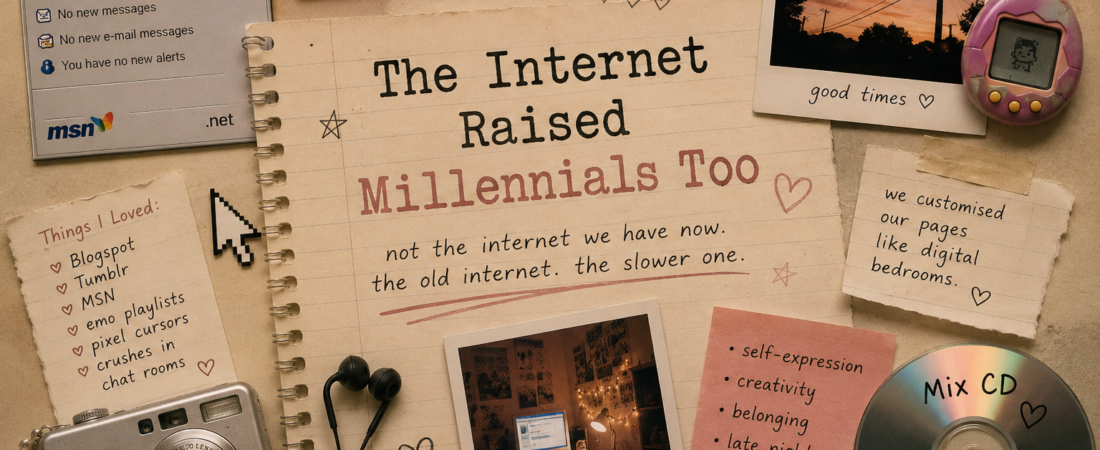
I don’t think people talk enough about how much the internet shaped millennials emotionally.
Not the internet we have now.
The old internet.
The slower one.
The one that screeched loudly through dial-up connections before finally letting you online like you had just unlocked a secret portal to another world.
Back then, the internet felt less like performance and more like escape.
Some of us rushed home after school just to log into MSN Messenger and see who was online. We customised our Blogspot pages like digital bedrooms. We wrote emotional Tumblr posts at 2am thinking nobody would ever read them.
And somehow, many of us quietly grew up there.
The internet became the place where millennials experimented with identity before we fully understood ourselves in real life.
It was where some of us learned:
- self-expression
- creativity
- humour
- emotional honesty
- community
- even comfort
Before algorithms started deciding what deserved to be seen, people simply posted things because they wanted to.
Badly edited photos.
Song lyrics as statuses.
Oversharing captions.
Glittery blogskins.
Autoplay music that nearly gave visitors a heart attack at full volume.
None of it needed to be perfect.
And maybe that’s why it felt real.
For many millennials, especially those who felt lonely offline, the internet became more than entertainment.
It became companionship.
A place to quietly exist.
A place where people with niche interests somehow found each other before “finding your community” became marketing language.
Some of us learned emotional vocabulary online before we ever heard it inside our own homes.
Some of us found comfort in strangers who understood our feelings better than the people physically around us.
And strangely enough, many online friendships back then felt incredibly genuine.
Maybe because nobody was trying to become a brand yet.
We were just people.
Awkward, emotional, oversharing people trying to figure life out together through MSN statuses, Tumblr reposts, fanfiction comment sections, and blurry webcam photos.
The internet raised millennials in ways older generations probably will never fully understand.
It shaped our humour.
Our communication style.
Our emotional language.
Our creativity.
Even the way we process nostalgia now.
And maybe that’s why millennials often feel emotionally conflicted about the internet today.
Because we remember a version of it that felt softer.
Slower.
More human.
Before everything became content.
Before every thought became branding.
Before vulnerability became monetisable.
Sometimes I think millennials miss the old internet because we miss who we were while using it.
Teenagers with usernames instead of personal brands.
Children learning ourselves quietly behind glowing computer screens while the rest of the house slept.
Maybe the internet didn’t just entertain millennials.
Maybe in some strange way, it helped raise us too.
Ummi Noi