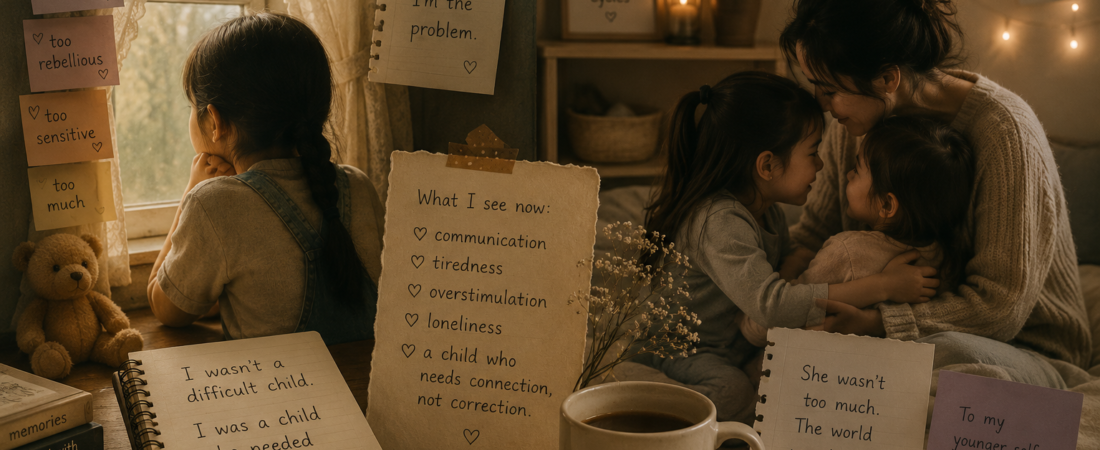
For the longest time, I genuinely believed I was a difficult child.
Too emotional.
Too rebellious.
Too sensitive.
Too much.
At least that’s what I quietly told myself growing up.
And honestly, I carried that belief into adulthood too.
It’s strange how children internalise things.
Adults can have bad days, financial stress, unresolved trauma, relationship problems — but somehow children often walk away believing:
> “Maybe I’m the problem.”
I think becoming a mother changed the way I see my younger self.
Because now, when I look at children, I don’t immediately see “bad behaviour.”
I see communication.
I see tiredness.
Overstimulation.
Loneliness.
Big emotions trapped inside small bodies that don’t yet know how to explain themselves properly.
And sometimes when my own children are overwhelmed, emotional, clingy, angry, or acting out… I catch glimpses of the child I used to be.
Not the “difficult” version.
The unseen one.
The one who probably needed comfort more than correction.
Looking back now, I realise many of my actions as a child were never about wanting to be troublesome. I think deep down, I just wanted to feel noticed.
Children don’t always know how to ask for love in ways adults recognise.
Sometimes they ask through noise.
Sometimes through anger.
Sometimes through silence.
Sometimes through becoming “problematic.”
And if those emotional needs go unseen for too long, children eventually adapt.
Some become overly independent.
Some become people pleasers.
Some become emotionally guarded.
Some grow up believing needing comfort makes them weak.
I think many millennials are now raising children while quietly grieving the childhood versions of themselves at the same time.
That’s why parenting can feel so emotionally exhausting sometimes.
Not just because we’re raising children.
But because parenting often reintroduces us to parts of ourselves we thought we had already buried.
Sometimes healing looks like learning emotional regulation alongside your child.
Sometimes healing looks like apologising after losing your patience because nobody apologised to you growing up.
Sometimes healing looks like choosing softness even when harshness was the language you were raised with.
And no, I don’t think parents from older generations intentionally wanted to hurt us.
Many of them were surviving too.
Many carried burdens we will never fully understand.
But understanding that now as an adult still doesn’t erase the loneliness some of us felt as children.
Both things can exist together.
Compassion for them.
And compassion for ourselves.
I think that’s one of the hardest parts of healing as a parent.
Realising the child version of you was never “too much.”
She was simply asking for something every child deserves:
to feel safe, seen, and loved loudly enough to never have to question it.
Ummi Noi