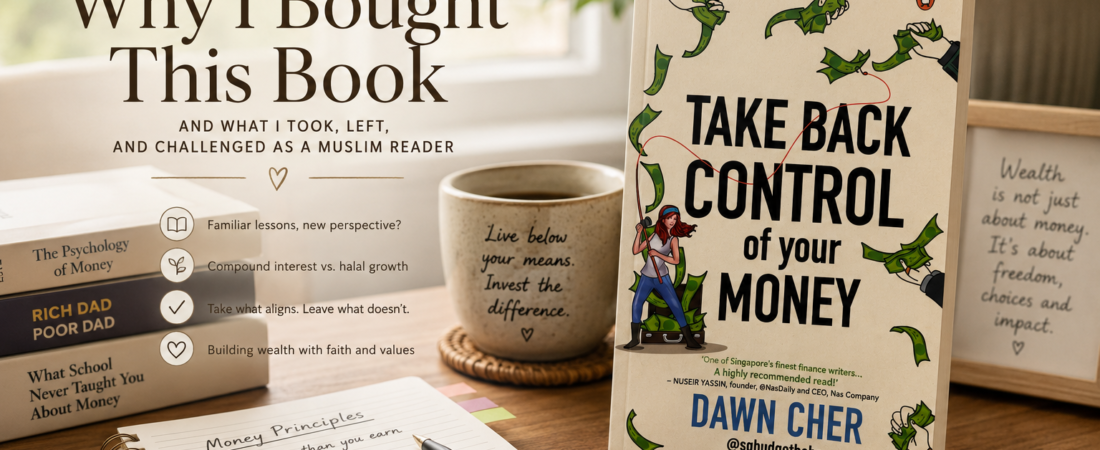
There are generally two kinds of books I buy.
The first are books that reinforce what I already know.
The second are books that challenge the way I think.
Take Back Control of Your Money by Dawn Cher fell into the second category or at least, I hoped it would. I don’t remember exactly where I first came across the book. It was probably a Threads post. Perhaps Instagram. What I do remember is that the title immediately caught my attention.
Take Back Control of Your Money.
It’s the kind of title that makes you pause for a second. Then I realised something else. The author is Singaporean.
That instantly made the book feel more relevant to me. Most personal finance books I’ve read are written from an American perspective. While many of the principles are universal, some examples don’t always translate neatly to life in Singapore.
Curious, I looked up Dawn Cher. She came across as knowledgeable, credible, and practical. She wasn’t promising overnight wealth or unrealistic financial freedom. Instead, she seemed genuinely interested in helping ordinary people become more intentional with their money. That was enough for me. I placed the order.
When the book arrived, I was genuinely excited. I always enjoy reading personal finance books because every author brings a slightly different perspective. Even when they’re discussing similar topics, I’m usually hoping to discover a new framework, a fresh story, or a way of looking at money that I hadn’t considered before.
As I worked through the book, however, my excitement slowly faded. Not because it was a bad book. It wasn’t. In fact, I think it’s a very good introduction to personal finance.
The reality was simply that I’d encountered many of the ideas before. One of the first moments that made me smile was when Dawn shared the story of Ronald Read, the American janitor and petrol station attendant who quietly accumulated millions through decades of disciplined investing. It’s an inspiring story.
But I’d already met Ronald Read while reading The Psychology of Money.
Later, I reached a chapter titled “Why Weren’t You Taught This in School?”
Again, I smiled. Not because I disagreed. But because another book on my shelf immediately came to mind: What School Never Taught You About Money.
By then, I began noticing a pattern.
It wasn’t just Ronald Read.
It wasn’t just one chapter title.
It was the recurring themes that kept appearing.
Spend less than you make.
Invest the difference.
Understand the difference between assets and liabilities.
Learn the difference between income and expenses.
Inflation quietly eats away at your purchasing power.
Avoid unnecessary debt.
Be careful with Buy Now, Pay Later schemes.
Build an emergency fund.
Negotiate for a salary raise.
Consider a side hustle.
Invest early because time is your greatest advantage.
Automate your investments through dollar-cost averaging.
Learn the basics of stocks, bonds and property.
Even the final chapters touched on Ikigai, and I couldn’t help but laugh because I already own that book too.
None of these ideas are bad advice. In fact, they’re good advice. The more finance books I read, the more I realise that many of them are teaching the same timeless principles through different stories, different examples, and different writing styles.
Some remind me of The Psychology of Money.
Others echo Rich Dad Poor Dad.
Some overlap with What School Never Taught You About Money.
They’re all having the same conversation from different angles. One thing I appreciated about Dawn’s book was that she didn’t simply explain concepts. She shared her own journey too. She wrote about becoming a tuition teacher and earning her own income. She shared stories of living frugally while studying in California. She reflected on her exchange programme at Tsinghua University in Beijing and how learning Mandarin and experiencing China later became valuable when working with Chinese business associates. Those personal stories made the book feel grounded.
They reminded me that personal finance isn’t just about numbers. It’s about the decisions we make throughout life. There was, however, one part of the book that made me pause for a different reason.
Dawn discusses compound interest and mentions the famous quote often attributed to Albert Einstein, that compound interest is the eighth wonder of the world.
It’s a statement I’ve encountered many times before. But this time, I found myself asking a different question. As a Muslim, if earning interest (riba) is prohibited, then what exactly compounds for us?
That question stayed with me longer than the chapter itself. The answer, I realised, isn’t interest. It’s ownership.
– Owning productive businesses.
– Owning shares in Shariah-compliant companies.
– Receiving halal profits and dividends.
– Owning assets that appreciate over time.
– Building wealth through trade, investment, entrepreneurship and productive ownership rather than lending money for guaranteed interest.
Even when Dawn compared keeping money in a regular savings account versus a high-yield savings account, or discussed bond allocations in a traditional 60/40 portfolio, I found myself mentally translating the ideas into alternatives that align with my own faith.
I wasn’t rejecting the principles. I was filtering them. That’s become one of the biggest changes in my own financial journey. A few years ago, I would have read a finance book trying to absorb everything. Today, I read with more discernment.
I ask myself:
“Does this align with my values?”
“Can I actually practise this?”
“How would this look from an Islamic perspective?”
That shift probably says more about me than it does about the book. In fact, I didn’t even read every page word for word. I found myself skimming through sections, slowing down only when a sentence or paragraph caught my attention. Not because the writing wasn’t engaging. But because many of the concepts had already become familiar territory.
Would I still recommend Take Back Control of Your Money?
Absolutely.
If you’re just beginning your personal finance journey, especially as someone living in Singapore, I think it’s a practical and approachable introduction. Dawn explains concepts clearly, shares relatable personal experiences, and encourages readers to become more intentional with their finances.
For Muslim readers, though, I’d recommend reading it with a thoughtful filter. Take the timeless principles. Learn from the mindset. Appreciate the stories.
But when you reach topics that don’t align with Islamic finance such as earning interest or investing in conventional bonds, recognise that there are halal alternatives worth exploring.
You don’t have to accept every strategy to benefit from the wisdom behind it.
Looking back, I’m still glad I bought this book. Not because it completely changed how I think about money. But because it reminded me how much my own thinking has changed. A few years ago, I was reading personal finance books searching for answers. Today, I’m reading them looking for alignment.
And perhaps that’s a sign that I’ve moved from simply consuming financial advice to intentionally building a financial philosophy, one that reflects not only my goals, but also my faith, my values, and the kind of legacy I hope to leave for my family.
Ummi Noi
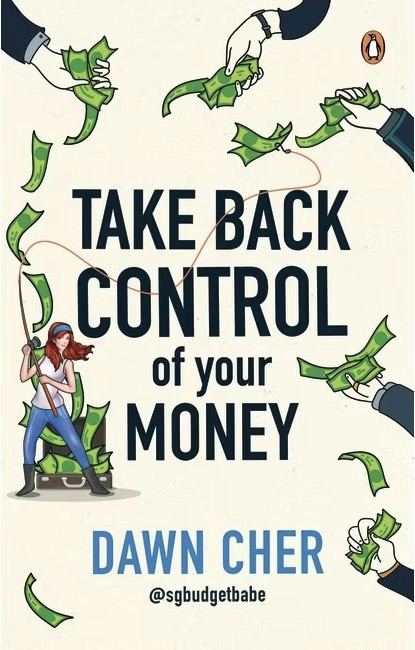
If you’d like to read Take Back Control of Your Money yourself, you can get a copy from whichever platform you prefer:
📚 Amazon: Click here for Amazon
🛍️ Shopee: Click here for Shopee
This post contains affiliate links. If you purchase through either link, I may earn a small commission at no extra cost to you. Thank you for supporting the time and effort that goes into writing these reflections.