In my previous entry, I wrote about how I somehow went from manually tracking my children’s prayers to building Little Sprout Ibadah, Qamari, SP: My Day and eventually Dear Future Me.
Four apps.
Three different AI-building platforms.
And one writer who still refuses to call herself a programmer. 😅
But there’s another part of that story I’ve been thinking about.
I never actually wanted to become a tech person.
Not secretly.
Not as some childhood dream I finally discovered in my thirties.
I wasn’t one of those children who wanted to know how computers worked.
I didn’t grow up wanting to learn programming.
I wasn’t fascinated by code.
Even when I started using AI seriously, my goal wasn’t:
I want to get into tech.
I wanted to write.
I wanted to create.
I wanted to solve problems.
I wanted to turn the ideas constantly living inside my head into something real.
Technology just happened to become one of the ways I could do that.
And actually, the story didn’t begin with app building.
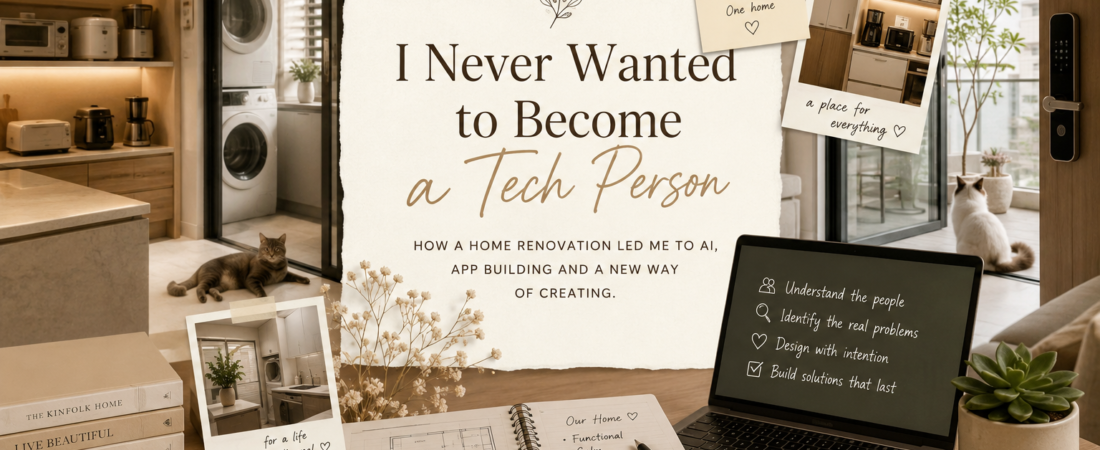
It began with my home renovation.
The First Time I Used AI Seriously Was For My Home
When we bought our five-room resale flat, I didn’t simply want to make it look beautiful.
I needed the home to understand how our family lived.
There were six of us.
Four children.
Four cats.
Schoolwork.
Laundry.
Meals.
Books.
Toys.
Appliances.
Children who still needed enough open space to have a childhood, while also having a home conducive enough for them to learn and grow.
I wasn’t trying to design a showroom.
I was trying to design a working family home.
And for AI to help me think through the renovation properly, it first had to understand our family nucleus.
Who lived there.
How we moved.
What frustrated us.
What we used every day.
What kind of mess appeared repeatedly.
What needed to remain accessible.
What needed to be hidden.
What would make everyday life easier years after the renovation photographs were taken.
That was the first time I really understood that AI could only give me useful answers if I gave it useful context.
Not:
Design me a nice kitchen.
But:
Here is my family. Here is how we live. Here is what this home needs to carry.
Every Renovation Decision Had A Reason
I wanted a service yard in our resale flat because I had loved having a separate laundry area in our previous BTO home. I liked the idea of laundry having its own zone. A place for washing, drying and everything that came with it, without allowing the whole process to take over the kitchen.
I chose sintered stone instead of quartz after considering how heavily our kitchen would actually be used. This wasn’t a kitchen designed only for aesthetics. It had to survive family meals, hot cookware, spills, constant cleaning and years of daily life.
For the bathroom, I chose a tiled shower partition wall instead of relying entirely on a glass shower screen. My interior designer then incorporated the recessed shower niche I wanted directly into the partition. I loved that.
The toiletries had a permanent place. No extra rack hanging somewhere. No bottles collecting around the floor. Nothing visually floating without a home.
That idea — that everything should have a home — shaped many of my decisions.
It was also why I fell in love with the idea of an appliance garage. I didn’t want the rice cooker, Thermomix and other appliances constantly migrating around the kitchen counters. I wanted to be able to use them without the kitchen always looking cluttered. Every appliance could have its own space. Accessible, but contained.
A dryer and dishwasher also made sense for us. I knew some people might see them as unnecessary luxuries. But for a household with four children, they weren’t about avoiding work. They were about reducing repetitive labour.
Laundry doesn’t become more meaningful simply because a mother spends more hours managing it.
Dishes do not become more virtuous because they are all washed by hand.
I wanted our home to support the reality of our family, not make life unnecessarily harder just to prove that I could cope. Even the balcony door was chosen around how the household functioned.
I wanted a trackless glass door so the robot vacuum could move across more easily to vacuum and mop. No raised track constantly collecting dirt. No awkward obstacle it had to keep navigating around.
A small decision, perhaps. But repeated daily, small design decisions can either reduce friction or keep creating it.
The same thinking applied to our bedroom doors. I wanted doors I could push open easily with my body when my hands were full. Because with children, laundry baskets, bags and random things constantly being carried from one room to another, my hands were very often full.
I chose digital locks for both the gate and main door for convenience and safety. No searching through my bag for keys while managing children and groceries. No wondering whether someone remembered to lock the door properly.
And I chose a tempered-glass gate because of the cats. With four cats, opening the wooden door without a secure barrier would mean immediately worrying about one of them running into the corridor. The glass gate allowed us to open the main door while keeping them safely inside. It was aesthetically nicer too, of course.
And if the wooden door was open, we could still switch on the living-room air-conditioning without leaving the entrance completely exposed.
Every choice had more than one job. Beauty mattered. But daily life mattered more.
I Was Already Designing Around People
Looking back, I can see that I was already doing the same thing I would later do when building apps. I was defining the user. The users just happened to be my own family. I was thinking about behaviour.
– How would we actually use this?
– Would the children remember to close it?
– Would the cats try to escape?
– Would this surface survive the way we cooked?
– Would this storage still be practical once the novelty wore off?
– Would this feature genuinely reduce the amount of work required?
– Would our robot vacuum be able to reach that area?
– Would the house still leave enough room for the children to move, play and grow?
I wasn’t choosing features because they sounded impressive. I was choosing them because I understood the people living there.
That same instinct would later shape Little Sprout Ibadah.
Qamari.
SP: My Day.
Dear Future Me.
The problem came first. The technology came afterwards. I just didn’t recognise that pattern yet.
Wait. Why Do I Know What That Means Now?
There have been moments recently when I’ve caught myself discussing something technical and thought:
Wait.
When did I learn this?
Not enough to sit down in front of a blank code editor and build an entire application from scratch. Let’s not get carried away here. 😂
But enough to understand what I’m looking at. Enough to know that the frontend and backend are doing different jobs. Enough to understand that data has to go somewhere. Enough to recognise that authentication isn’t simply a login screen magically appearing. Enough to know that one change can break something somewhere else. Enough to ask better questions when something doesn’t work. And perhaps most importantly, enough not to panic immediately when I see something technical.
That might be the biggest change.
Previously, the moment something looked remotely like code, my brain would categorise it as:
Not for me.
Now? I might not understand it yet. But I no longer automatically assume that means I can’t. There is a surprisingly large difference between those two things.
I Think We Decide Too Early What Kind Of Person We Are
Somewhere along the way, many of us collect these little identity labels.
I’m creative.
I’m analytical.
I’m good with numbers.
I’m bad with numbers.
I’m a words person.
I’m not technical.
I’m not artistic.
I’m not good at this kind of thing.
Then we quietly build fences around ourselves using those sentences.
I definitely did. I was a writer.
Technology belonged to other people.
People who studied Computer Science.
People who could look at a wall of code without wanting to close the tab immediately.
People who knew what they were doing.
Meanwhile, I had stories.
Parenting resources.
Books.
Digital products.
Those were my things.
Except apparently the border between those worlds wasn’t nearly as solid as I thought. Because once I started building with AI, I discovered that many of the skills I already had travelled with me.
I knew how to communicate an idea.
I knew how to think about an audience.
I knew how to organise information.
I knew how to notice when something felt confusing.
I knew how to revise.
I knew how to ask:
But why would someone use this?
And:
Would this actually make sense to them?
Those weren’t coding skills. But they were incredibly useful building skills.
I Didn’t Need A New Identity. I Needed A Bigger One.
I think this is where I’ve landed. Learning technology doesn’t require me to stop being a writer. Building apps doesn’t cancel out storytelling. Using AI doesn’t mean everything I create suddenly needs to become an AI product.
I don’t need to replace:
writer
with:
tech person.
I can simply expand what being a writer allows me to do. That feels much more natural to me. Because I don’t wake up in the morning thinking about technology. I wake up thinking about ideas.
Sometimes those ideas become blog entries.
Sometimes they become books.
Sometimes they become parenting resources.
Sometimes they become digital products.
Sometimes they become systems inside my home.
And apparently, sometimes they become apps.
The medium changes. The instinct underneath it doesn’t.
I see something.
I wonder about it.
I think:
There should be something for this.
Then I start trying to make it exist.
AI Made Curiosity More Useful
Before AI, there were plenty of things I was curious about but never pursued very far. Not because I didn’t care. Because the entry point felt too high.
If learning something required me to understand fifty unfamiliar concepts before I could even experiment with the idea that interested me, there was a good chance I wasn’t going to do it.
I had children to raise. Work to do. Stories to write. A household to run.
I wasn’t looking for another entire profession to master. AI changed that learning process for me.
I could ask the embarrassing beginner question.
Then ask another one.
Then say:
No, explain that to me like I genuinely have no idea what you’re talking about.
Then ask why.
Then ask what would happen if I changed something.
Then break it.
Then come back and ask why I broke it. 😭
There was no need to pretend I understood.
And because I could learn while actually making something I cared about, the knowledge stuck differently. I wasn’t memorising terminology because I thought I might need it one day.
I was learning something because:
I need to solve this problem right now.
That was true when I was deciding how our home should function. It was true when I was choosing materials. It was true when I was trying to understand whether a renovation idea suited our family. And it remained true when I eventually began building apps.
Technology felt less like a subject I was studying and more like a language I was slowly picking up through use.
Context Changed Everything
The renovation process also taught me something that would later become central to how I used AI. A generic question often produced a generic answer. The more context I provided, the more useful the conversation became.
It wasn’t enough to ask:
Should I get a dishwasher?
AI needed to understand that I had four children. That meals created a large volume of dishes. That I was thinking about the long-term daily workload of the household. That saving time in one area could free up energy for something else.
It wasn’t enough to ask:
Should I install a glass gate?
It needed to understand that I had four cats.
That I wanted airflow and visibility.
That I wanted to open the wooden door safely.
That appearance mattered, but containment and security mattered too.
It wasn’t enough to ask which kitchen countertop was best. It needed to understand how we cooked. How often the kitchen would be used. What kind of maintenance I was willing to tolerate.
I learned that AI was far more helpful when it understood the whole story.
Later, when I began building Little Sprout Ibadah, I didn’t simply say:
Build me a prayer tracker.
I explained my children. Our routines. What I was already tracking manually.
What would encourage them.
What might overwhelm them.
Why Ramadan Mode mattered.
Why the app still needed to remain useful for the rest of the year.
When I built Qamari, I didn’t say:
Build an Islamic period tracker.
I explained why I didn’t want menstruation to become the centre of a Muslim woman’s spiritual life.
Why ibadah needed to come first.
Why missed fasts mattered.
Why azkar mattered.
Why transliteration needed to remain optional.
The app builders changed. The type of project changed. But the method remained strangely familiar.
Here is the person.
Here is how they live.
Here is the problem.
Here is what the solution needs to understand.
And I Still Don’t Want To Learn Everything
This part feels important too. Just because AI makes learning more accessible doesn’t mean I suddenly need to become an expert in everything.
I don’t.
There are rabbit holes I could disappear into for months. There will always be another platform.
Another AI model.
Another tool.
Another feature.
Another thing the internet insists you absolutely MUST learn before everyone else does.
I don’t want to spend my life chasing all of it. That’s not why I’m here.
The goal isn’t to collect technical knowledge for the sake of saying I have it. The goal is to learn enough to create what matters to me. That distinction has become increasingly important.
Because AI makes possibility feel almost endless. And endless possibility can become its own kind of distraction.
Just because I can build something doesn’t mean I should.
Just because a new tool exists doesn’t mean I need to use it.
Just because everyone is talking about the newest AI platform doesn’t mean my work suddenly needs it.
Sometimes the most useful question isn’t:
What can this technology do?
It’s:
Does this help me make the thing I’m already trying to make?
If the answer is no, I can leave it alone.
The Technology Was Never The Interesting Part
This is probably why I still hesitate when I hear the phrase “tech person.” Because when I think about our home renovation, the technology isn’t the part I care about most.
I care that our home was designed around the six people and four cats actually living inside it.
I care that the children still have space.
That learning has a place.
That laundry has a place.
That appliances have a place.
That the cats can remain safely inside.
That repetitive household work can be reduced.
When I think about Little Sprout Ibadah, I care that it began because I wanted to help my children become more consistent with their ibadah.
When I think about Qamari, I care that Muslim women deserve something that sees their spiritual lives as more than a menstrual cycle.
When I think about SP: My Day, I care about the overwhelmed person who doesn’t need another app shouting at them to become more productive.
And when I think about the things I haven’t built yet, I don’t begin with:
Which AI tool should I use?
I begin with the person.
The problem.
The story.
Technology comes later. Maybe that’s why this whole journey has felt less like entering the tech world and more like discovering another creative medium.
Because That’s What It Feels Like Now
A novelist has words.
An illustrator has images.
A filmmaker has moving pictures.
A musician has sound.
An interior designer shapes how people move through a space.
And increasingly, creators can also make things that respond.
Things people can click.
Things people can interact with.
Things that remember information.
Things that change depending on what someone needs.
Things that do something.
That possibility fascinates me far more than technology itself. The idea that something can begin as a sentence inside my head —
I wish there was something that could…
— and eventually become something another person can open and use.
Or walk into.
Or live inside.
That feels like storytelling expanded beyond the page.
Maybe “Tech Person” Was The Wrong Question Anyway
I spent years assuming technology belonged to people who understood technology. Now I think that was backwards.
Technology is a tool.
And tools become interesting when people from completely different worlds pick them up.
A teacher will imagine something a software engineer might never think to build.
A caregiver will notice problems invisible to someone who hasn’t lived that experience.
A small business owner will understand frustrations that don’t appear inside a technical specification.
A mother renovating a home for four children and four cats will ask questions that might never appear inside a design catalogue.
A mother manually tracking her children’s prayers might look at an AI app builder and think:
Wait.
Could I make this easier?
That’s where I entered. Not through code. Through a problem.
And perhaps that’s why I don’t feel like I’ve crossed into some completely different identity. I’m still standing in the same place. I’m just holding more tools now.
I’m Still A Writer
That hasn’t changed. If anything, this whole experience has made me understand my identity as a writer differently.
Writing taught me how to observe.
How to ask questions.
How to sit with an idea long enough to understand what I’m actually trying to say.
How to imagine another person’s experience.
How to take something that exists only inside my head and slowly give it structure.
Those skills followed me everywhere.
Into my home.
Into digital products.
Into AI.
Into app building.
Into whatever I end up creating next.
I never wanted to become a tech person. And strangely enough, I still don’t.
I don’t think that’s the transformation happening here.
The transformation is that I no longer look at technology and think:
That’s not for someone like me.
Now I look at it and think:
Is there something here I can use?
And if there is, I’ll learn it.
Not because I want to become a programmer.
Not because I’m trying to chase every new AI trend.
Not because I’ve abandoned the writer I was before all of this started.
But because sometimes the story I want to tell belongs in a book.
Sometimes it belongs in a blog entry.
Sometimes it becomes a resource a parent can print and place on the fridge.
Sometimes it becomes a home designed around the people living inside it.
And sometimes, apparently, it needs buttons. 😅
I’m still a writer.
I’m still a mother.
I’m still a storyteller.
I just don’t tell myself anymore that certain tools aren’t meant for me.
Ummi Noi