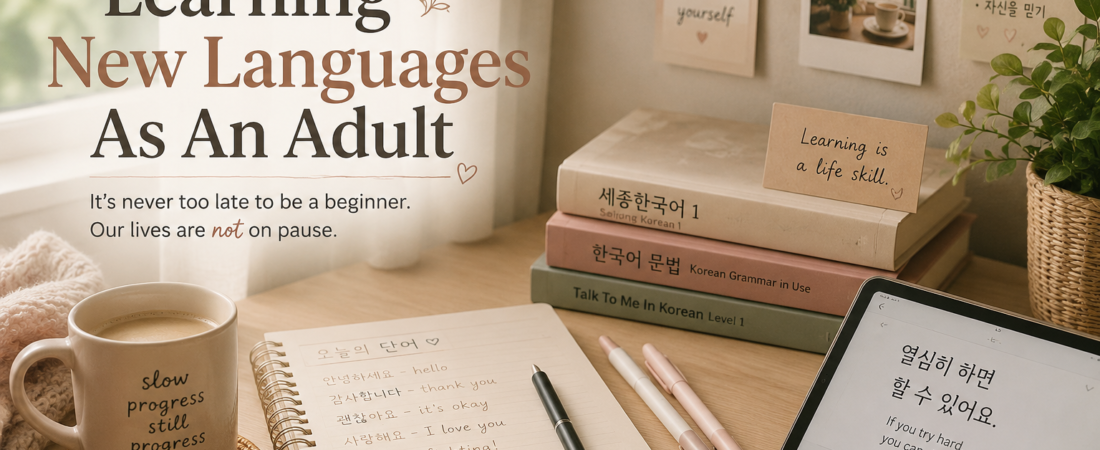
If you had told me ten years ago that I would spend my thirties learning Korean, I probably would have laughed.
Not because I disliked languages.
Because by then, I thought life would already be decided.
Adults don’t learn new things for fun, right?
Adults work.
Pay bills.
Raise children.
Repeat.
At least that’s what I thought.
Somewhere along the way, I quietly accepted the idea that learning belonged to younger people.
Students.
Teenagers.
University kids.
People who still had their whole lives ahead of them.
Not mothers with laundry waiting to be folded.
Not women trying to remember if they had already defrosted the chicken for dinner.
Not people who accidentally fall asleep halfway through a television show.
And yet, here I am.
A mother of four.
Watching Korean language videos.
Practising Hangul.
Celebrating when I successfully read a sentence that would have looked like complete nonsense a year ago.
The funny thing is, learning Korean was never really about Korean.
Not entirely.
The truth is, Korean has been quietly following me for much longer than I realised.
I first picked up a few Korean words back in secondary school during the second-generation K-pop era.
The usual ones.
Annyeong.
Saranghae.
Enough to recognise them online.
Enough to throw them around with friends.
But not enough to actually understand the language.
And honestly, I wasn’t interested in learning anything beyond that.
At the time, it was just another trend passing through my teenage years.
Years later, K-dramas changed something.
For the first time, I found myself wanting to understand what was being said without relying completely on subtitles.
I became curious about the language itself.
The sounds.
The expressions.
The little cultural nuances that sometimes get lost in translation.
I started noticing familiar words.
Recognising patterns.
Wondering what else I was missing.
But like many interests we have as adults, that curiosity quietly sat in the background.
Life was busy.
Marriage happened.
Children happened.
Responsibilities happened.
And before I knew it, years had passed.
Then BTS entered the picture.
Not as the beginning of the story.
But as the spark that reignited it.
I wanted to understand more.
The interviews.
The jokes.
The little moments that subtitles couldn’t always fully capture.
I wanted to hear their words and understand them directly.
At least a little.
So I downloaded Teuida then Duolingo.
Then followed Korean language accounts.
Then started watching videos.
Then found myself ridiculously excited over recognising words on signboards during my trip to Seoul.
The progress has been slow.
Painfully slow sometimes.
I still make mistakes.
I still mix things up.
Some days I feel like I know absolutely nothing.
But that’s part of the experience too.
Because when you’re a child, nobody expects you to be good immediately.
When you’re an adult, we’re often embarrassed to be beginners.
We think we should already know.
Already be competent.
Already have everything figured out.
Learning a new language forces you to become a beginner again.
And honestly?
That’s probably what I needed.
Not just for Korean.
For life.
Somewhere in my twenties, life became very serious.
Marriage.
Children.
Responsibilities.
Survival.
There wasn’t much room left for curiosity.
Everything had a purpose.
Everything needed a result.
Everything needed to be productive.
Learning Korean was one of the first things I did simply because I wanted to.
Not because it would earn money.
Not because it would improve my career.
Not because anyone expected me to.
Just because I was curious.
And that felt surprisingly healing.
Maybe that’s why learning as an adult feels different.
You’re no longer learning because someone told you to.
You’re learning because some part of you still believes there’s more to discover.
About the world.
About other people.
About yourself.
These days, I still get excited when I recognise a phrase.
I still smile when I manage to read something correctly.
I still have a very long way to go.
But I think that’s the point.
The goal was never perfection.
The goal was remembering that growth didn’t end when school did.
For the longest time, I thought adulthood meant becoming a finished version of yourself.
Now I think adulthood is the opposite.
It’s realising you’re allowed to keep evolving.
Allowed to stay curious.
Allowed to begin again.
Even at 33.
Especially at 33.
And maybe that’s why learning Korean means so much more to me than just learning another language.
It’s a reminder that the parts of ourselves we leave behind don’t always disappear.
Sometimes they wait patiently.
For years.
Until we’re finally ready to come back.
And in my case, that journey started with a few words in secondary school, grew through years of K-dramas, and eventually led me back to a language I had been quietly circling around for almost half my life.
Ummi Noi