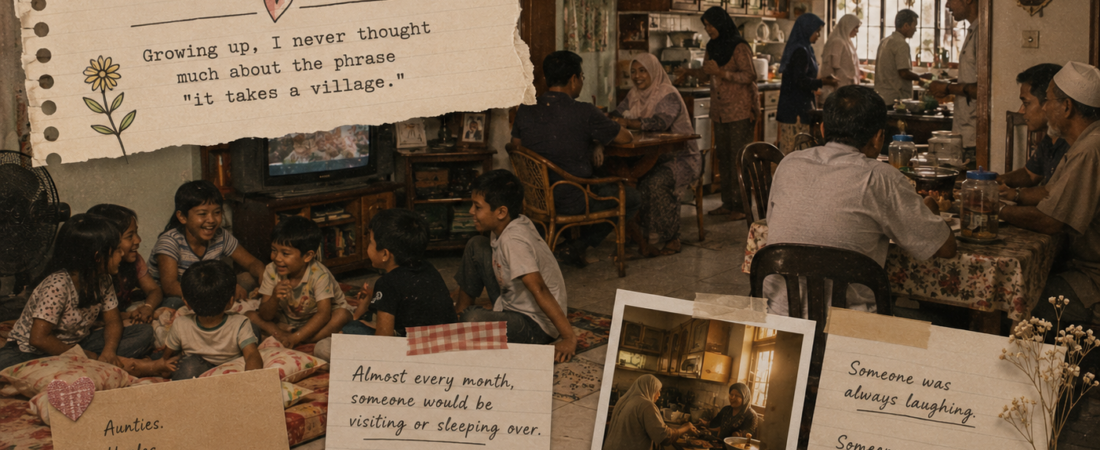
Growing up, I never thought much about the phrase “it takes a village.”
Because I had one. On my father’s side alone, there were eleven siblings.
Aunties.
Uncles.
Cousins.
Half-cousins.
More people than I could keep track of.
Almost every month, someone would be visiting or sleeping over. Mattresses would be pulled out and laid across the living room floor. Cousins sprawled everywhere. Someone was always laughing. Someone was always cooking. Someone was always talking.
The house never felt empty. At the time, I thought that was normal. I thought every family was like that.
Then my grandmother passed away.
And somehow, without anyone officially announcing it, the tradition slowly disappeared. The gatherings became smaller. The sleepovers became rarer. People got older. Life got busier.
The village scattered.
My mother worked most of the time when I was growing up. The people who looked after me were mostly my grandfather and my youngest aunt. Looking back now, I know my aunt tried her best.
She showed up. She cared. She carried responsibilities that probably should never have belonged to someone so young herself.
But there was always a space that nobody quite knew how to fill. A child doesn’t always need someone to feed them. Sometimes they need someone to sit beside them.
To notice things.
To explain things.
To make the world feel a little less confusing.
Since I was young, I was already helping to take care of younger siblings. Sometimes cousins too.
I knew how to carry babies.
I knew how to entertain children.
I knew how to keep an eye on them.
From the outside, it probably looked like I already knew what I was doing. But knowing how to look after children and knowing how to nurture them are completely different things. Nobody tells you that.
When I became a mother, I realised how many things I didn’t know.
Not practical things.
Not how to change diapers.
Not how to prepare milk.
The deeper things.
Breastfeeding.
Attachment.
Emotional regulation.
How to respond instead of react.
How to comfort a child when you were never fully comforted yourself.
I remember learning so much from conversations with my sister-in-law.
Small things that experienced mothers sometimes assume everyone knows.
Things I had never been taught.
My parents-in-law helped too.
In their own ways, they tried to fill gaps I didn’t even realise existed.
And I remain grateful for that.
But motherhood still felt lonelier than I expected. Not because I didn’t have people around me. But because there wasn’t a ready-made village waiting the way there had been when I was a child.
There was no living room full of mattresses. No army of aunties passing babies around. No cousins running through the house. No grandmother anchoring everyone together.
There was just me. Trying my best. Learning as I went. Making mistakes. Figuring things out one child at a time.
Sometimes I wonder what my grandmother would think if she saw all of us now. Her grandchildren raising children of our own. Scattered across different homes. Different schedules. Different lives.
I wonder if she would recognise how much of the village disappeared when she did. Or maybe she already knew. Maybe that’s why she spent so much time gathering everyone together while she could.
These days, I understand something I couldn’t understand when I was younger. A village isn’t just practical help. It’s belonging. It’s knowing there are people who will show up. It’s having somewhere to fall apart when you’re tired. It’s children growing up surrounded by people who love them.
And maybe that’s why so many mothers quietly grieve the villages they no longer have. Not because we want constant help. But because once upon a time, we knew what it felt like to belong to one. And some part of us still misses it.
Ummi Noi