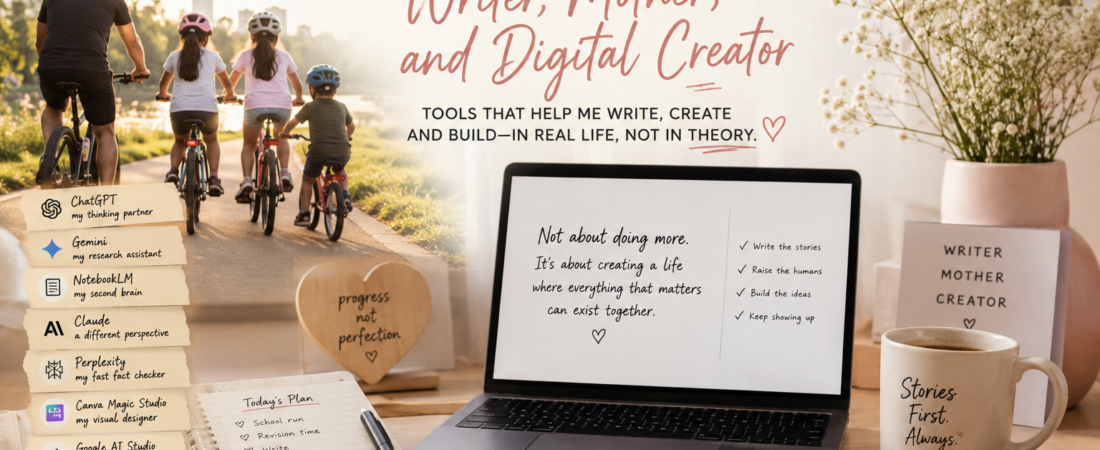
Yesterday, 12 August, my older children didn’t have school because of the PSLE Oral examinations. Therefore we went cycling as a family.
Nothing particularly productive happened during those hours. I wasn’t sitting at my desk writing a blog post, building an app, designing a product, or planning content. I was outside with my husband and children, cycling.
Today, they’re home again for the same reason. I still sent my youngest to school because his preschool is running as usual, while my husband went to work. The older kids did some revision at home, then later went out to meet their friends. Somewhere in between, they even volunteered to fetch their youngest brother from school.
I’m here, working in between everything else. This is the most honest way to explain why AI has become part of how I work. I’m not in an office with uninterrupted hours.
I’m a writer.
A mother of four.
I build digital products and brands.
I’m also managing revision, meals, questions, schedules, and the occasional spontaneous family outing when school is off. My work has to fit into a life that is already full. Somewhere along the way, I built an AI stack that helps me do exactly that.
Not intentionally. I didn’t wake up one day thinking I needed an “AI stack”. The tools simply earned their place in my workflow.
ChatGPT Is Where Most Things Begin
This is the AI I use most. ChatGPT is my thinking partner. I throw it half-formed thoughts. Sometimes a sentence. Sometimes a messy essay disguised as a rant.
Sometimes I’m unpacking why something bothered me, thinking through parenting decisions, or shaping a product idea that doesn’t fully exist yet. And sometimes I already know what I want to say, I just need help untangling it.
Most of my writing starts this way.
Not:
“Write me a blog post about motherhood.”
But:
“Something happened today and it made me think about this…”
Then I talk. And refine. And usually remember more along the way.
By the time I write the draft, the substance is already mine. That matters to me, because I don’t want AI to manufacture my life for content. I already have a life worth writing about. I just want help seeing the story inside it.
Gemini Gives Me Another Brain in the Room
I don’t want a single AI that always agrees with me. I take ideas elsewhere too. Gemini might surface something I missed, or challenge an assumption. Sometimes I get multiple interpretations and realise I don’t fully agree with any of them. That’s useful. I’m still the one deciding.
AI doesn’t need to tell me what to think. It just needs to give me more to think about. This is especially helpful when I’m researching or comparing ideas and don’t want a single perspective shaping my thinking.
NotebookLM Helps Me Work With What I Already Have
Being a writer and creator means you accumulate a lot of material.
Drafts.
PDFs.
Research.
Notes.
Ideas you were sure you’d remember and didn’t.
The more I create, the more I need tools that work with my own material instead of constantly generating new content. That’s what I like about NotebookLM. It lets me interrogate what I already have. My biggest challenge isn’t ideas. It’s retrieving, connecting, and finishing them.
AI Studio Made Me Realise I Could Build Things
This still makes me smile. I’m a writer. I didn’t study Computer Science. Yet I’ve built AI-powered apps.
Google AI Studio made building feel less like something reserved for “technical people”.
I could prototype.
Experiment.
Break things.
Fix them.
And most importantly, turn ideas into something I could actually use. That shift from I wish this existed to maybe I can build this has been one of the biggest changes in my creative life.
Then There Are My AI App Builders
This is where things moved beyond writing. When I built Little Sprout Ibadah, I used Base44. It started from real life: I was manually tracking my children’s prayers.
Then I kept seeing AI app builders and eventually thought, why not try?
That experiment became a working app with Parent Mode, Kids Mode, partner access, and even a Ramadan toggle so it could extend beyond a single season.
Then came more experiments.
Emergent.
Google AI Studio.
Different tools for different ideas.
I wasn’t trying to become an app developer.
I was solving problems I already had.
AI just made that overlap possible.
Canva Helps Me Turn the Story Into Something Visual
Writing is only part of being a digital creator.
Eventually, a blog post needs a cover image.
An Instagram post needs to exist.
A product needs packaging.
A carousel somehow becomes twelve slides instead of five.
This is where Canva and other AI-assisted design tools come in.
I still make the decisions.
What does this feel like?
What colours belong here?
Does this communicate what I mean?
Does this look like me?
AI speeds up options, but taste still matters.
In fact, it matters more now.
When anyone can generate visuals, knowing what to keep becomes the real skill.
I Don’t Use Every AI Tool I See
I ignore a lot of tools. There’s always another AI platform. Another subscription. Another “this changes everything” video. Another promise to automate your entire life. I don’t need all of them.
Every tool adds complexity. So I focus on a small ecosystem that actually fits how I work.
I ask:
Does this help me write?
Research?
Build?
Turn existing work into something useful?
Does it save enough time to matter?
If not, I don’t use it.
The Point Isn’t to Produce More and More
This is perhaps the biggest misconception about why I use AI. Yes, I can produce more with it. Obviously. But that’s not actually the part I care about most.
Yesterday I went cycling with my family. Today my children are home.
There will be homework questions. Someone will eventually be hungry. Someone will need something from me. My youngest needs to be fetched from school although today his sisters have happily taken that job.
And I still get to write. I still get to build.
I still get to create things that may eventually become intellectual property, products, books, apps and businesses. That’s what AI gives me. Not an escape from my life. A way to build within it.
My Real AI Stack Isn’t Software
The tools will change. I’m almost certain some of the AI platforms I use today won’t be the ones I use five years from now. Models will get better. New companies will appear. Some subscriptions will disappear from my debit card statement and new ones will probably sneak in. But the centre of the stack doesn’t change. It’s still me.
The writer who notices things. The mother living the stories before she ever writes them. The creator trying to turn some of those ideas into things that can live beyond an Instagram post.
AI sits around that. It helps me research faster. Think more clearly. Prototype sooner. Design faster. Find connections. Turn scattered thoughts into something I can actually finish. But it doesn’t give me the life I’m writing about.
Yesterday’s family cycling trip wasn’t generated by AI. My daughters volunteering to fetch their little brother today wasn’t generated by AI. The children growing up around me aren’t prompts. They’re my life.
Perhaps that’s why I’ve never felt particularly threatened by the idea of being an AI-assisted writer. AI can help me find the words. But first, I still have to live the story.
Ummi Noi