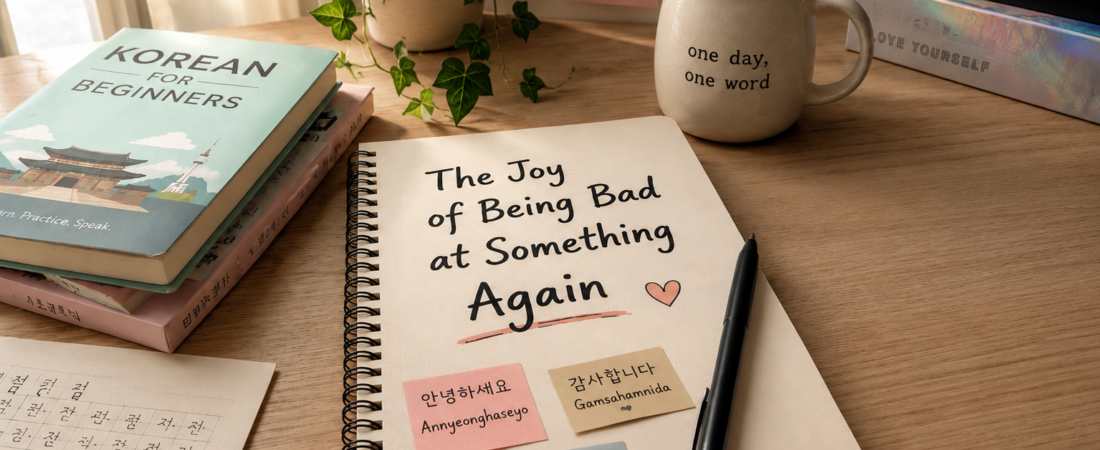
If you had told sixteen-year-old me that I would spend my thirties learning Korean, I probably would have laughed.
Like many millennials who grew up during the second-generation K-pop era, Korean music was simply part of the background of my teenage years.
There was Super Junior. BigBang. Wonder Girls. SHINee. Girls’ Generation. Then 2NE1 debuted. Before long, it felt like there was a new group every other week.
I learnt a few words without really trying.
– Annyeonghaseyo.
– Gamsahamnida.
– Saranghae.
The usual phrases that seemed impossible to avoid if you spent enough time listening to K-pop. But I never felt motivated to learn the language itself.
At some point, the constant stream of new groups became overwhelming. Life moved on. My interests shifted. Without realising it, I drifted away from K-pop entirely. Which is why I completely missed BTS when they debuted.
Years later, Korean dramas entered my life instead. Again, I picked up bits and pieces of the language through exposure. Certain phrases became familiar. Certain expressions felt oddly comforting. But familiarity and commitment are two very different things.
Learning a language felt like something other people did. Not me.
Then sometime in my thirties, I decided to give Korean a proper try. At first, it was fun.
Learning Hangul felt like solving a puzzle. Every new word felt like progress. I could almost convince myself that I was making real headway.
Then grammar arrived. And particles. And sentence structures. And all the things that make language learning humbling.
Suddenly, I wasn’t effortlessly consuming content anymore. I was struggling. Making mistakes. Forgetting things I had already learnt. The novelty wore off. The frustration arrived. For a while, I quietly backed away.
Then BTS came back with a new album. What started as curiosity turned into a rabbit hole. I began looking into their story. Their early years. Their struggles. The uncertainty they faced. The way they kept going when success was far from guaranteed.
Somewhere along the way, I became ARMY. Not because of their music alone, but because of their resilience. I fell in love with the story. Then I fell in love with the content.
Before I knew it, I was watching Run BTS episodes, interviews, livestreams, documentaries, and countless moments that reminded me why people connect so deeply with them.
And something unexpected happened. Korean stopped feeling like a subject. It became a bridge. I no longer wanted to learn Korean because learning a language seemed productive. I wanted to understand the jokes before the subtitles appeared. I wanted to catch the little exchanges that never get translated. I wanted to understand the emotions hidden between words. I wanted to experience those moments directly, even if only a little.
So I started again. Not because it was easy. But because it mattered.
These days, my goal is surprisingly simple.
By the time I attend their concert later this year, I would love to understand at least some of what they’re saying during their ment before the translations appear on screen. Will I become fluent by then? Almost certainly not.
Will I still mix up grammar rules and forget vocabulary? Definitely. But maybe that’s the point.
As children, we’re constantly learning things we’re bad at. As adults, we quietly avoid them. We stick to what we’re already good at. We protect our competence. We avoid looking foolish.
Somewhere along the way, we forget that being bad at something is often the first step toward becoming good at it. Learning Korean has reminded me of something I hadn’t realised I needed to remember.
There is joy in being a beginner. There is joy in struggling. There is joy in discovering that your brain can still stretch in new directions.
And sometimes, all it takes is finding a reason that matters enough to try again.
Maybe this story was never really about Korean.
Maybe it was about giving myself permission to start over.
To be inexperienced.
To be uncomfortable.
To be bad at something again.
And finding joy there anyway.
Ummi Noi