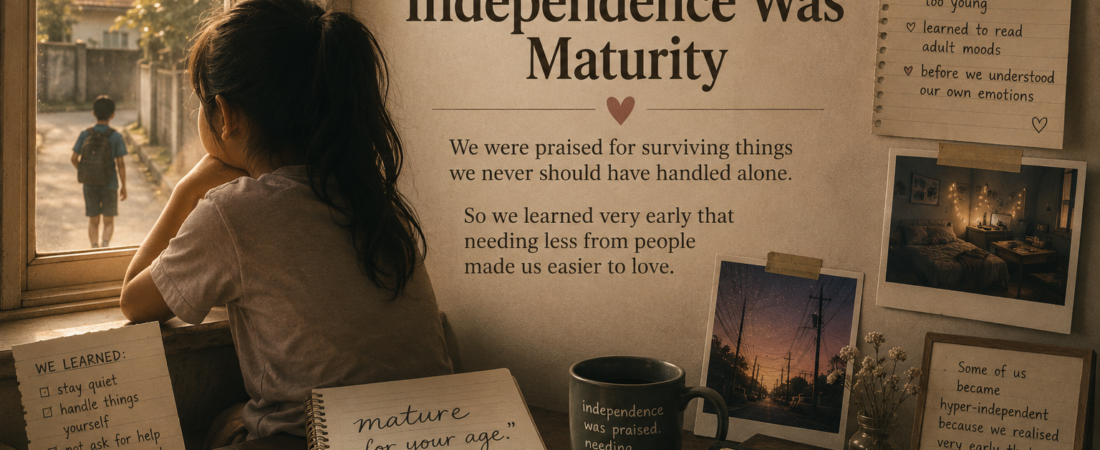
I think a lot of millennials were praised for surviving things they never should have handled alone.
And because of that, many of us grew up believing independence was maturity.
If you could stay quiet,
handle things yourself,
not ask for help,
not cry too much,
not burden anyone—
people called you “mature for your age.”
So we learned very early that needing less from people made us easier to love.
Some of us walked home from school alone far too young.
Some of us learned how to read adult moods before we even understood our own emotions properly.
Some of us became hyper-independent not because we were confident…
but because we realised very early that nobody was really coming to rescue us emotionally.
At the time, it didn’t even feel sad.
It just felt normal.
You adapt to the environment you grow up in.
And I think that’s why many millennials struggle with rest, softness, vulnerability, and asking for help now as adults.
Because independence became our survival mechanism.
Even now, I still catch myself feeling guilty when people help me too much.
A part of me immediately wants to say:
“It’s okay, I can do it myself.”
Not because I genuinely want to do everything alone.
But because somewhere deep inside me, independence still feels tied to safety.
And maybe that’s the exhausting part about growing older as a millennial.
We’re now adults trying to unlearn survival patterns that once protected us.
We’re trying to teach our children emotional safety while still figuring out what emotional safety even feels like for ourselves.
We’re learning that maturity is not:
- suppressing emotions,
- carrying everything alone,
- or never needing support.
Real maturity might actually be:
allowing yourself to soften without feeling ashamed for it.
And honestly?
I think many millennials are only discovering this now in their thirties.
Not because we’re slow.
But because we spent most of our younger years trying to survive adulthood before we even fully experienced childhood.
Ummi Noi